The 3 a.m. bleeder.
You launched a 4× banger Tuesday. By Thursday it’s 0.8× and burning $400 a day in waste. By the time you check the manager, the damage is already cooked into the week.
A bleeder dies at 9:14 on a Tuesday. No one touched a thing.
ROAS.to isn’t an AI improvising with your budget. It’s your rules, enforced against every campaign, every minute — pause the bleeders, scale the winners, log every move. You set the lines. The desk holds them.
$499 / month flat · replaces a stack averaging $3,573 / mo
“By 6 a.m. the bleed was already paused. I came down for coffee, opened the desk, and the worst hours of the week had already been handled.”
You launched a 4× banger Tuesday. By Thursday it’s 0.8× and burning $400 a day in waste. By the time you check the manager, the damage is already cooked into the week.
Meta’s scoreboard and your bank account tell different stories. Until you can see which one is real, you’re scaling losers and killing winners.
Thirty checks a day. Glued to the dashboard like a day trader — except day traders have stop losses. You don’t.
Other tools handle one slice — automation, or A/B, or tracking. ROAS.to owns ad management and post-click optimization, so what happens on the page changes how your ads run. The rules engine can pause an ad because the lander it points at stopped converting — not because Facebook said so.
Batch creation launches new campaigns through one validator. 30 ads in 2 minutes.
Clicks land tagged with sub-IDs, tracked at session level — not Meta’s estimate.
Landing variants tested live. Winners promote automatically. No flicker, no waiting.
Real conversions, not Facebook’s guess, written to your ledger via sub-ID match.
Automation pauses, scales, or duplicates on real data — not vanity metrics.
Proven angles duplicated with fresh AI-written hooks. The cycle restarts.
None of these tools talk to each other. That’s the actual problem.
The watcher handles every minute. These three handle everything else.
Bulk-launch through one validator. Every Meta format, every placement, every regulated category — without wizard-walking Ads Manager on repeat.
Copy, scripts, images, audits — each reading from your brand profile. Capped to a monthly spend you set. Every call logged.
Server-side CAPI ships Stripe-true revenue back to the optimizer — not Meta’s guess. Shopify and Everflow plug straight in.
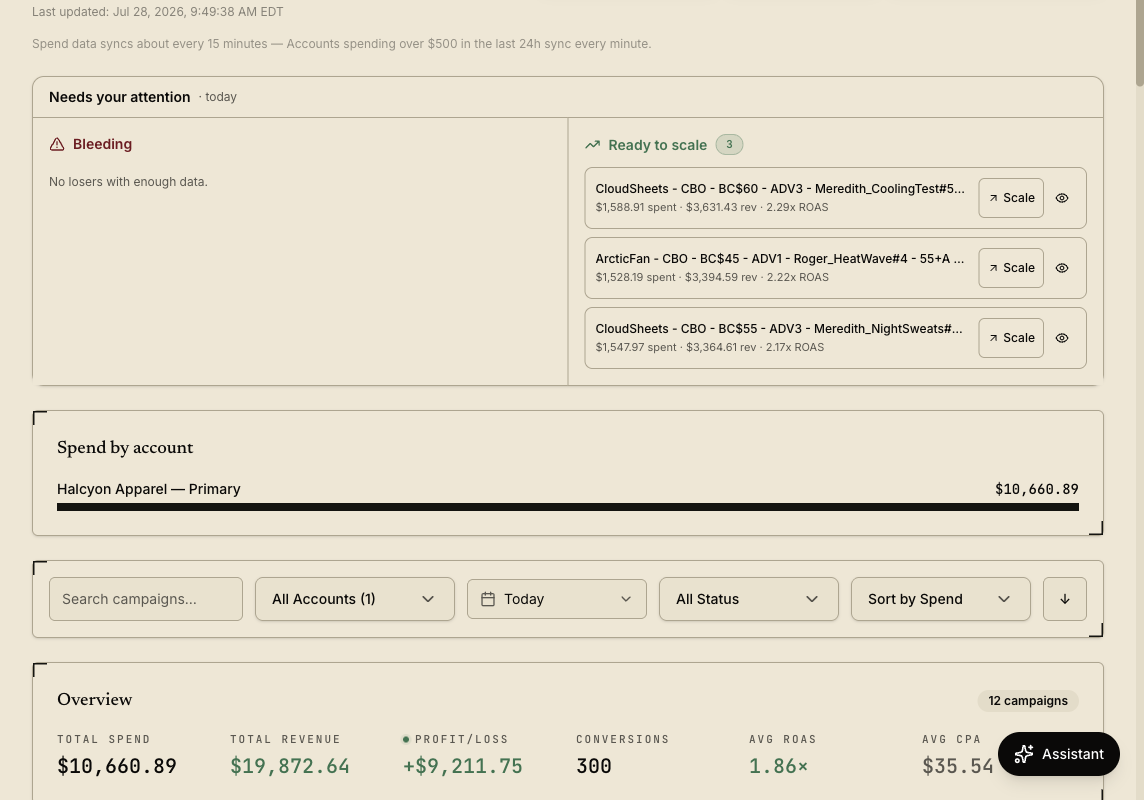
Everything here runs off the same data. No CSV exports between tools.
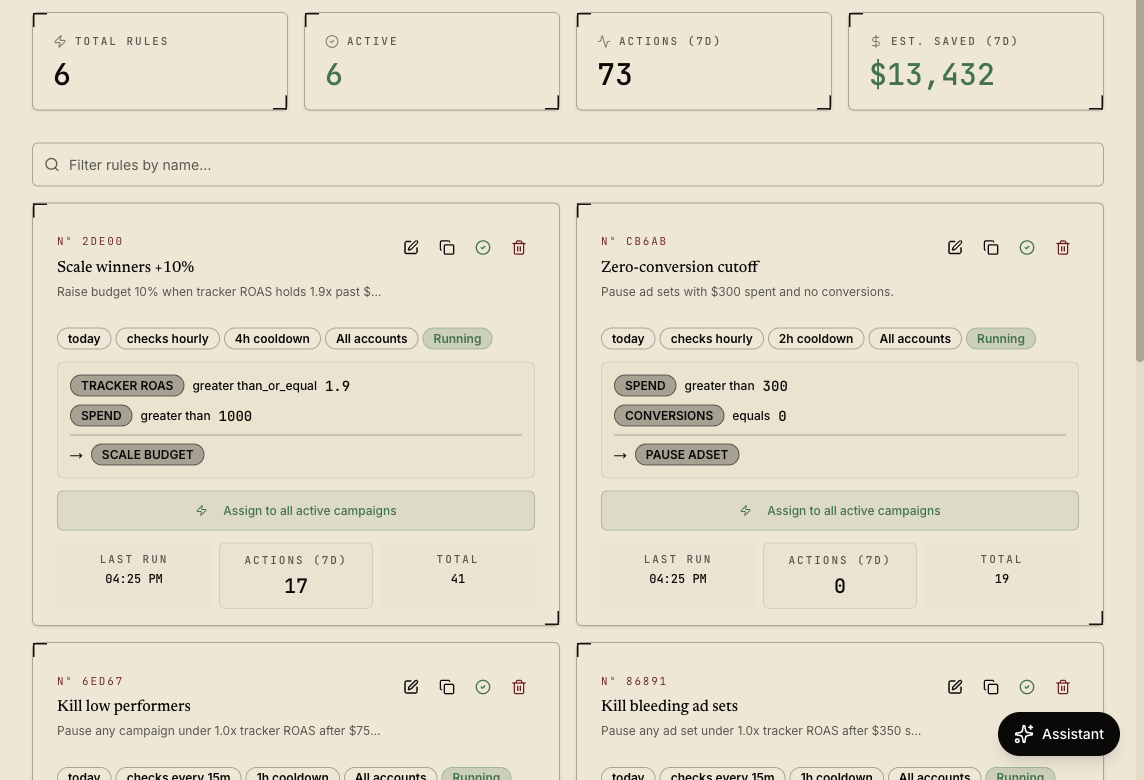
The rules engine fires every minute against your real-time book. The Bayesian split-tester reroutes traffic toward whatever’s converting. Both run on their own — no babysitting.
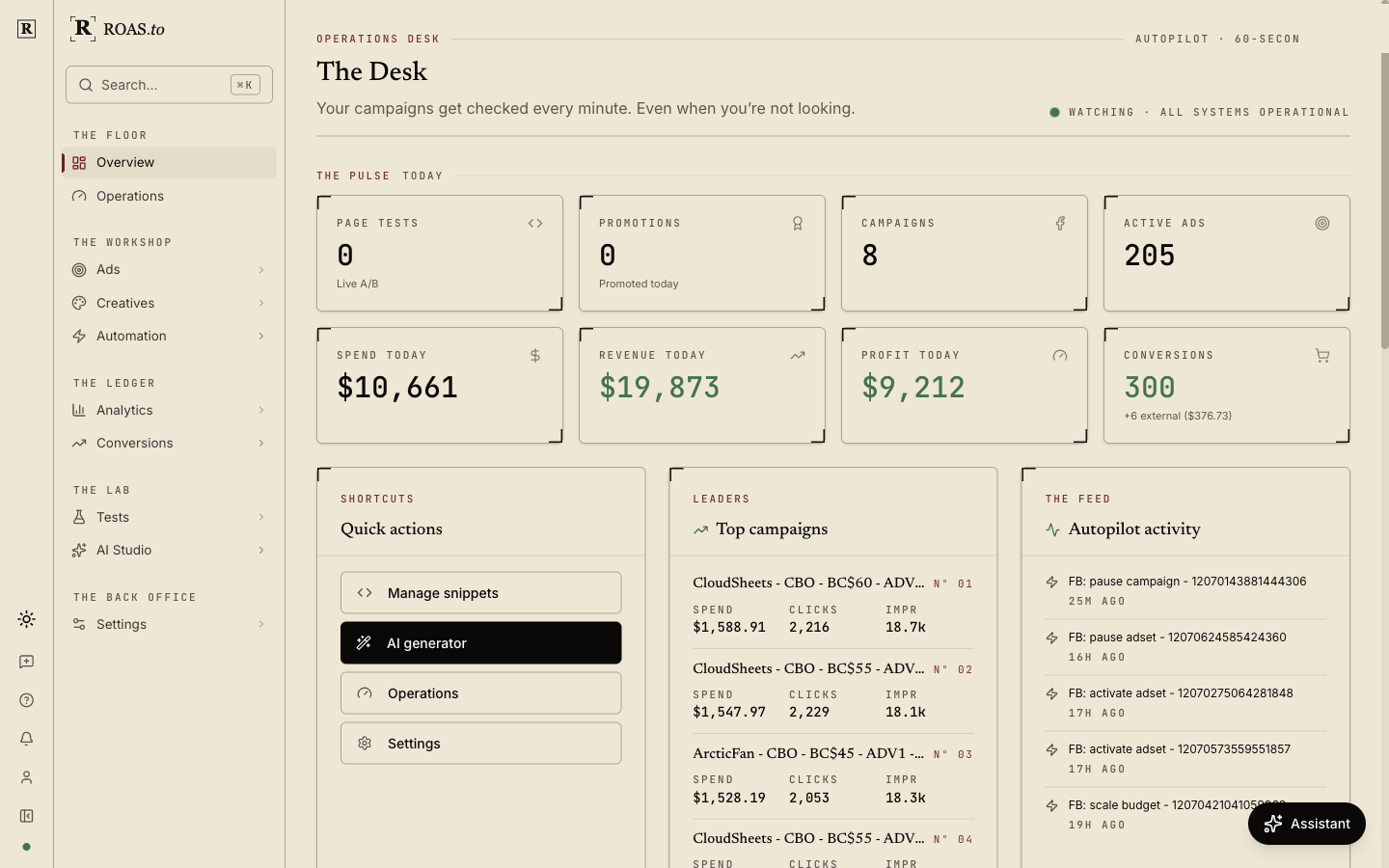
ROAS.to was our private desk before it was a product. Since fall 2025 it has run our own book: a small team, seven ad accounts, $0.7–1.5M a month on Meta. These numbers come from its ledger, not a case study.
The best save. Thursday, May 7, 9:36 a.m. New York. A campaign burning $650 a day at 0.15× — fifteen cents back on the dollar — hit the floor rule and was executed on the spot. Nobody was at the desk. That same rule fired 1,543 times last quarter.
The best scale. May 2, 9:58 a.m. A campaign crossed 1.9× with $1,000 down. The scale rule raised its budget 10%, re-checked every hour, and kept going. One week later, $4.5k of weekly spend had become $152k and ROAS had eased from 1.66× to 1.32×. Every campaign that rule touched, in aggregate: six times the spend, margin nearly flat.
Whether your book runs 1.1× at $36k a day or 3.5× at $2k, the job is the same: kill what’s under your line, scale what’s over it, fast. At $36k a day, a tenth of a point of ROAS is about $108k a month. That’s what the desk is there to defend.
* Net losing spend halted over 90 days, conservative methodology: spend run-rate at pause × observed pause duration (capped at 48h), with profitable pauses counted as zero. All figures from our internal ledger, fall 2025 → July 2026, first-party tracked revenue — not Meta’s estimate.
Giving software the keys to your ad account is a hire. You’d ask for references and a paper trail. Here’s both.
Every rule carries a budget cap, a cooldown, and a daily action limit. A runaway rule costs its cap, not your account.
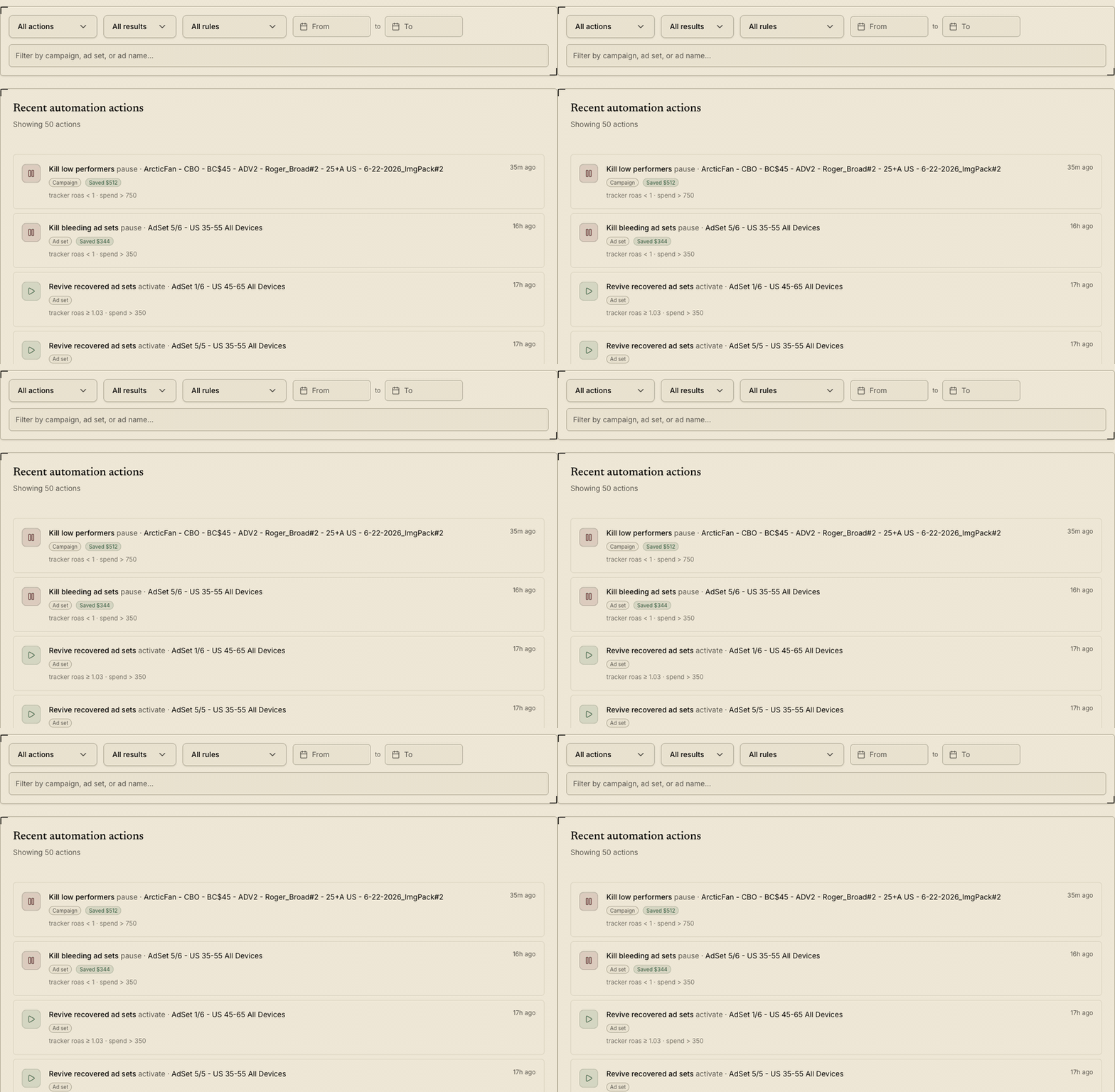
Each decision is logged with the condition that triggered it and the action it took. Nothing fires off the record.
The desk watches every change after it lands. On our own book it once reverted a bid change by itself when ROAS fell 55% past the guardrail.
Every action pings Telegram or Slack as it happens. So does stale data or a failed launch. You’re never the last to know.
Pause one rule or the whole desk. Automation stops, data keeps syncing, and nothing gets deleted.
Connect and just watch. The desk changes nothing until you switch on a rule. Start with one kill rule and widen from there.
Replace your automation tool, A/B platform, tracker, attribution stack, and ad-creation workflow — at one price that doesn’t grow when you scale.
| Capability | ROAS.to | TheOptimizer | RevealBot | Voluum | VWO | Why it matters |
|---|---|---|---|---|---|---|
| 1-minute sync (not hourly) | ✓ | · | · | · | · | Your $400/day bleeder is paused in minutes, not after lunch. |
| Landing page A/B testing | ✓ | · | · | · | ✓ | Test the page and the ad together — neither layer waits on the other. |
| Campaign cloning with AI headlines | ✓ | ~ | · | · | · | Find a winner Tuesday morning, ship ten clones by Wednesday. |
| Full-funnel click attribution | ✓ | · | · | ✓ | · | Stripe-true revenue, not Meta’s optimistic guess. The number your CFO believes. |
| Budget guardrails & spend caps | ✓ | ✓ | ✓ | · | · | A bad rule firing at 3 a.m. burns $200, not $20,000. |
| Ad management + post-click in one tool | ✓ | · | · | · | · | No layer hands stale data to the next layer. The desk decides once. |
| One flat price, everything included | ✓ | · | · | · | · | Your $1.4M month costs the same as your $40k month. No upgrade conversation. |
Five subscriptions that don’t know each other exist.
All of it. One bill. The number doesn’t move when you scale.
Stack sized for a media buyer running $200k/mo on Meta. Prices sourced from voluum.com, vwo.com, theoptimizer.io, adespresso.com, and motionapp.com — April 2026. Overage fees and tier caps apply as published. Your stack bill grows with your volume. Ours doesn’t.
No dev work. No onboarding call.
One-click Login for Business. Data starts syncing in 60 seconds. Power users can use system-user tokens.
Takes 1 minTell the copilot what you want in plain English (“pause anything under 1× after $50”) and approve the draft. Or write the rules yourself.
One line of JavaScript on your landing page. Variations test automatically; winners promote in real time.
The desk syncs every minute, fires rules, optimizes pages, and clones winners. Check in when you want — not because you have to.
Autopilot engagedSame plan whether you spend $10k a month or $2M. No sales call to find out the real number.
3 days free. No card required. Cancel anytime.
After 3 days, $499/mo to continue — or pause (data frozen, never deleted).
AI features usage-based with a $50/mo hard cap. Every call logged.
DTC brand at $10k/mo? A 0.3× ROAS lift is $3k/mo in extra revenue — the desk pays for itself six times over in month one.
Affiliate at $200k/mo? Your competitor stack bills you $3,573/mo today and charges more the second you scale. $499/mo flat is a rounding error on your spend. The line doesn’t move when your spend does.
I started building ROAS.to in 2025 because we were paying TheOptimizer $10k a month and it still couldn’t tell us which ads were actually making money. So I built something that worked. The first morning it ran cleanly end-to-end, my partner launched the day’s ads from his phone while walking the dog. That’s still the moment I come back to — like the job finally got smaller. If you run paid traffic for a living and your stack feels heavier than the work, I built this for you.
Founder
No. ROAS.to is a Meta Verified Tech Partner — Meta audited the platform and signed off. Every Graph call goes through official OAuth and API keys. No scraping, no shared accounts. The token lives in your account; you can revoke it from Facebook settings in two clicks.
Facebook’s rules check every 15 to 30 minutes, can’t combine more than two conditions cleanly, and can’t see anything past the click. The desk syncs every minute, runs multi-condition logic with dayparting, and ties ad behavior to what’s actually converting on the lander.
No. You connect via Facebook Login for Business — the same OAuth flow every major ad platform uses. Grant access in one click, revoke any time from Facebook settings. The desk reads what it needs through Meta’s official APIs. It never sees your password.
You and the teammates you invite — nobody else. Every row in the database is isolated to your account, so other operators on the platform can’t see your accounts, your numbers, or your creatives. Facebook tokens are encrypted at rest. In writing: your data is never sold, never shared, and never used to train AI models.
Yes. Deletion is a first-class flow, not a support ticket. Disconnect Facebook and request deletion from settings — or through Facebook’s own data-deletion mechanism — and your data is purged, with a confirmation code you can check against our public deletion-status page. Cancelling freezes your data; deletion erases it.
They automate ads. The desk runs the watcher, the workshop, and the attribution layer — every layer feeding the next. RevealBot can’t test pages, can’t clone with AI, and can’t sync faster than hourly. Madgicx is mostly a creative-side tool with thin rules. We do all of those, plus the post-click layer.
Traditional A/B splits traffic 50/50 and asks you to wait for significance. The desk judges every variant on revenue per visitor and moves traffic as evidence accumulates — winners earn more, losers get less, and it will tell you outright when there is no winner to find so you stop burning clicks on a dead test.
Yes. One line of JavaScript on any page — WordPress, Webflow, Shopify, ClickFunnels, custom HTML — and variations serve from Cloudflare’s edge. No flicker, no performance hit, no server-side rendering changes.
Every rule carries a budget cap and a per-target cooldown — a misconfigured scale rule firing in a loop costs $200, not $20,000. Every execution is logged with the conditions it saw and the action it took. Pause any rule — or all of them — in one click; the audit trail tells you exactly why it fired.
About ten minutes. Sign in with Facebook Login for Business, point the desk at your ad accounts, set a couple of starting rules. Data starts syncing in 60 seconds. Three days of full access before any card is required.
AI features pass through the underlying provider’s token costs (Claude, GPT, Gemini) with a hard monthly cap you set — default $50/month, move it as you like. Every call is logged with the model, tokens, and dollar cost. Most operators run under $20/month.
The desk changes nothing until you tell it to. Connect first, let the real attribution data come in for a week, then turn on one rule — "pause anything under 1× ROAS for the last 24 hours" is the safest start. Expand from there once the desk has earned your trust.
No. The desk runs alongside them. Pixel and postbacks are additive — the same conversion will show up in both stacks if you double-install, with cross-source dedup on the ROAS.to side so revenue isn’t double-counted. Most operators eventually consolidate once attribution proves out, but you don’t have to choose on day one.
The desk syncs every minute. If it’s worth $499/mo to you, you’ll see it inside 72 hours of live spend — usually inside 24. A longer trial mostly means a SaaS hoping you forget you signed up.
Yes — the desk ships its own MCP server and a full REST API. Point Claude (or anything that speaks MCP) at it with a scoped key and read your book, launch batches, or manage rules from chat, with the same caps, approval gates, and audit log as the dashboard. What we don’t recommend is the DIY version — an agent polling Meta directly. We ran that experiment for sixty days on real spend: the connection drops on weekend mornings, Meta rate-limits it, and there’s no post-click layer. That’s why the desk exists.
Yes. One click from your dashboard. Automation pauses, data freezes, nothing gets deleted. If you ever come back, your account picks up where it left off.
3 days of full access. No card required.
Start free · 3 days full accessMost operators see the desk catch its first underperformer inside 24 hours.
* Customer names in testimonials are anonymized for privacy; the underlying outcome is real. Ticket samples shown in the hero are illustrative of the autopause format — figures are modeled on real decisions from our own accounts; identifiers and verticals are changed. Product screenshots are captured from a live demo workspace running the real product; the track-record figures in The Book come from our internal production ledger.